


Introduction to micro-nano bubble generator
Tiny bubbles existing in a liquid are called micro bubbles when their diameters are below 100 micrometers (μm), and nano bubbles when the diameters are below 100 nanometers (nm). Micro-nano bubbles refer to bubbles with diameters ranging from tens of micrometers to hundreds of nanometers at the time of generation. These bubbles are between micro bubbles and nano bubbles and possess physical and chemical properties that conventional bubbles do not have.
The micro-nano bubble generator mainly consists of two parts: the generating device and the releasing device. It needs to be connected with supporting pipelines, mainly including the gas inlet pipeline, the water inlet pipeline, the water outlet pipeline, and the releasing device. When the gas enters the generating device through the gas inlet pipeline, it fully mixes with the raw water. After being processed by the device through stirring and mixing, etc., micro-nano bubbles with a diameter of less than 50 micrometers are generated. Then, these bubbles are released in the form of aeration through the releasing device.
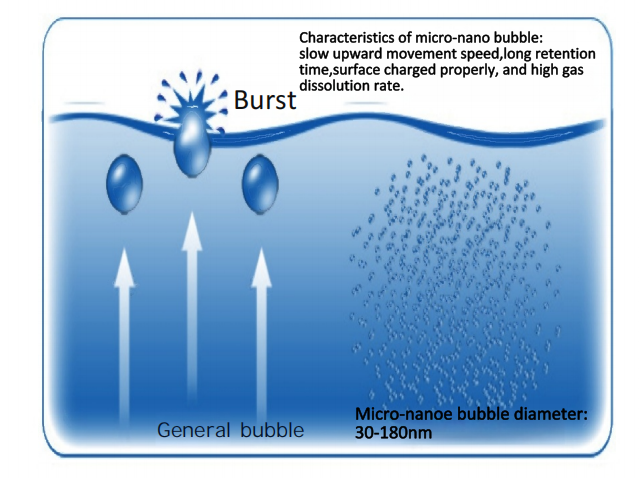
Characteristics of micro-nano bubble
- Large specific surface area
- High gas dissolution rate
- Generate a large amount of free radicals
- Bubble surface charged
- High mass transfer efhciency
- Self pressurized dissolution
- Slow rising speed
The principle of micro-nano bubble generator
The principle of XINOZONE’s micro-nano bubble generating device is to enable a high degree of dissolution and mixing between gas and liquid. It uses a dynamic high-speed shearing device to cut up the bubbles in the gas-liquid mixture. Due to the powerful shearing force of these components, the bubbles can be cut into sizes ranging from dozens of nanometers to several micrometers, and finally, milky white micro-nano bubbles are formed. This method can take into account both the gas-liquid mixing and the generation of micro-bubbles, and it has the characteristic of gas-liquid process intensification.
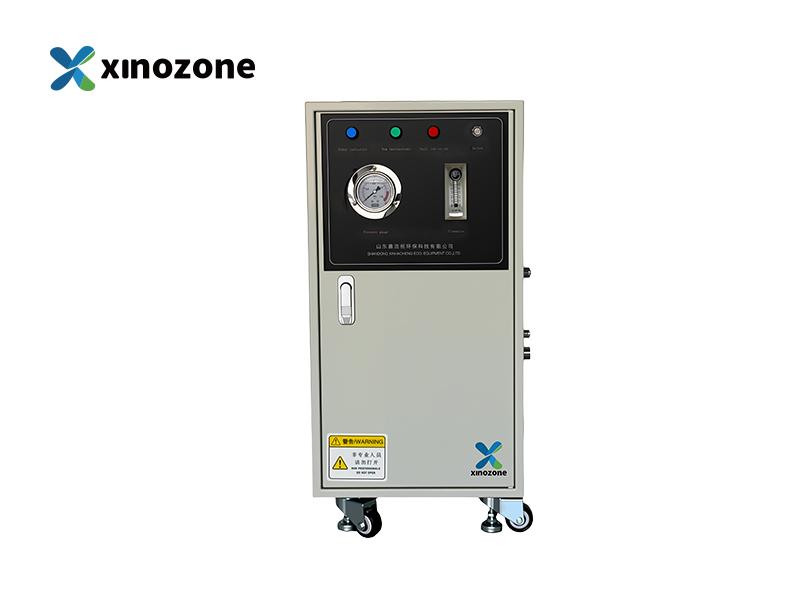
Parameter
| Model | X-MN-550 | X-MN-1100 |
| Power | 0.55KW | 1.1KW |
| Work pressure | 0.3-0.5Mpa | 0.4-0.6Mpa |
| Power supply | 220V/50Hz | |
| Rated flow | 800L/H | 1800L/H |
| Intake flow | 0.1-1.5L/Min | 0.1-2.5L/Min |
| Applicable liquid range | 50-2000L | 100-6000L |
| Weight(kg) | 45 | 55 |
| Size(cm) | 35×45×72 | 35×45×122 |
| Control method | Manual operation (customizable touch screen control) | |
| Dissolution rate | 85-99% | |
| Air source selection | Air, pure oxygen, ozone, hydrogen, carbon dioxide, etc. | |
| Overcurrent component | 304 stainless steel (different materials can be customized according to needs) | |
| Liquid temperature | ≤60℃(customizable) | |