Access to safe drinking water is vital—not only for satisfy our basic need for hydration, but also for maintaining personal health, enabling society to function, and supporting economic growth. Ozone treatment is an advanced oxidation process that plays an essential role in drinking water purification. It is a key step in ensuring water safety and enhancing its quality.
Drinking water can be categorized into four main types, depending on its source and how it’s treated:
Ozone is an unstable gas, typically generated by corona discharge. It acts rapidly and effectively against a broad spectrum of microorganisms, including viruses and bacteria. Ozone also breaks down organic pollutants thoroughly without leaving harmful residues.
In drinking water treatment, ozone serves multiple roles: it not only disinfects but also helps remove color and odor, controls algae growth, and improves overall water quality and taste. As an eco-friendly option, it leaves no chemical residue and avoids the secondary pollution often associated with disinfectants like chlorine dioxide.
Ozone is highly effective against even the most resistant pathogens, such as viruses and spores, and remains the most potent disinfectant in such cases. Its germ-killing power is unaffected by changes in pH or the presence of ammonia.
In pure water systems, ozone sterilization is widely used. The residual ozone level is usually maintained between 0.05–0.5 mg/L. Disinfection happens almost instantly—at concentrations of 0.3–2 mg/L in pure water, ozone can eliminate bacteria within 0.5 to 1 minute. As long as the water turbidity remains below 5 mg/L, ozone’s effectiveness is largely unaffected.
Ozone is commonly used in drinking water treatment, mainly in the following scenarios:
Tap Water Production
A key reason for using ozone instead of chlorine is that many water sources are now polluted with industrial organic compounds. When chlorine reacts with these substances, it forms harmful by-products like chloroform and carbon tetrachloride—known carcinogens. Ozone, however, breaks down pollutants through oxidation without creating such hazardous residues. As a result, many water suppliers are switching from chlorine to ozone for disinfection.
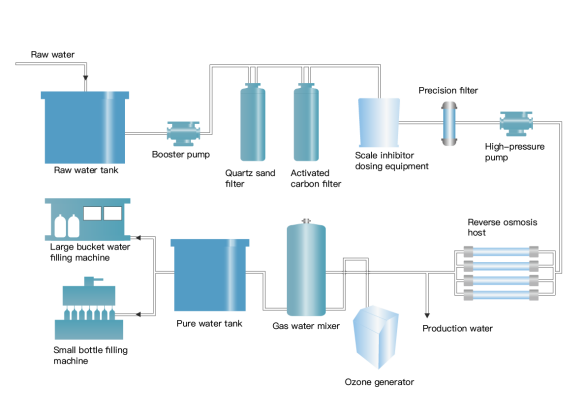
Sterilizing Mineral Water, Purified Water, and High-Quality Drinking Water
Ozone water, with a concentration of 0.1–1.5 mg/L, is effective for disinfecting production lines, pipes, containers, bottles, and barrels. It eliminates a wide range of microbes, including bacteria, E. coli, yeast, and Aspergillus niger.
In China, ozone is the most widely used purification method in the bottled water industry. Over 1,000 plants producing mineral, pure, and filtered water rely on it, with about 60% using ozone sterilization. Technical supervision and public health authorities now consider ozone treatment essential, making it difficult for bottled water producers without ozone systems to compete.
To ensure effective disinfection, the dissolved ozone level should reach 0.3–0.5 mg/L. This typically requires adding about 2 grams of ozone per cubic meter of water. Proper mixing and sufficient contact time are also crucial for the ozone to work thoroughly.

Calculation of Ozone Demand
The required ozone dosage can be calculated using the following formula:
O₃ (g/h) = 1.06 × D (g/m³) × Q (m³/h)
Where:
O₃ = Ozone required (g/h)
D = Ozone dosage (g/m³)
Q = Water flow rate (m³/h)
*1.06* = Design coefficient
XINOZONE Ozone Generator X -ST Treatment Effect of Drinking Water
Ozone generator X-ST sterilization effect test
Sample name | Total bacterial count of water sample (cfu/ml) | Residual bacterial count after 20 minutes of ozone machine operation (cfu/ml) | Sterilization rate (%) |
Ozone generator X-ST | 2.80 * 10 | 63 | 99.78 |
Conclusion: The data shows that after 20 minutes of operation, the sterilization rate of the ozone detoxification machine is as high as 99.78%, indicating that it has a very significant sterilization effect.