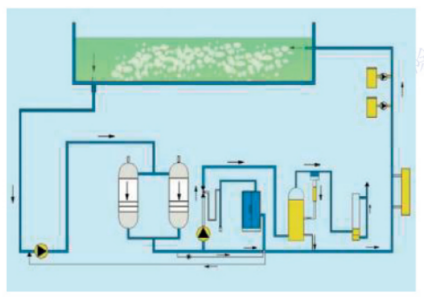
Several original treatment methods for circulating water in swimming pools and their comparison
① Chemicals ② Filter ③ UV equipment ④ Sodium hypochlorite generator
⑤ Ozone generator
Provide a detailed explanation of the most commonly used swimming pool water treatment methods.
① Chemicals (such as liquid chlorine, bleach powder, sodium hypochlorite solution)
Advantages: Stable disinfection effect, low cost, and easy operation. Residual chlorine can provide continuous disinfection ability and inhibit microbial regeneration.
Disadvantages: Strong irritant odor, easily causing discomfort in the eyes and respiratory tract; Long-term exposure may produce harmful by-products (such as trichloromethane). Corrosive pipelines and equipment require strict monitoring of the dosage to prevent safety accidents.
② Filter element filtration (such as laminated filter)
Advantages: Efficient removal of suspended solids and solid particles, with a large filtration area, suitable for high flow scenarios. The material is corrosion-resistant (such as stainless steel, and polypropylene), has a long service life, and is easy to clean and maintain.
Disadvantages: It is only applicable to physical filtration, unable to kill microorganisms, and needs to be used in conjunction with disinfection equipment. The filtration accuracy is limited and ineffective for ultrafine particles or soluble pollutants.
③ UV disinfection equipment
Advantages: No chemical residues, skin-friendly; It can efficiently inactivate bacteria, viruses, and cryptosporidium. Environmental protection and energy conservation, especially with UVC LED technology as the trend, flexible adaptation to small devices.
Disadvantages: It has no continuous disinfection ability and needs to be used in conjunction with chlorine agents. Lamp tubes are prone to scaling and reduced efficiency, requiring regular cleaning and replacement; Weak penetration and sensitivity to water turbidity. The equipment and maintenance costs are relatively high.
④ Sodium hypochlorite generator (electrolytic brine for chlorine production)
Advantages:
High safety, on-site chlorine production avoids transportation and storage risks; No harmful by-products.
The disinfection effect is equivalent to liquid chlorine, and residual chlorine provides continuous protection; The cost of raw materials (salt, electricity) is low.
Disadvantages: The electrolysis process generates hydrogen gas, which requires ventilation and explosion prevention. The initial equipment investment is relatively high, and the electrolytic cell needs to be regularly cleaned.
⑤ Ozone generator for swimming pool
Advantages:
Strong oxidizing sterilization efficiency is extremely high (600-3000 times that of chlorine), with no chemical residue.
Degradable organic matter significantly improves water clarity.
Easy to operate, highly integrated, with low equipment footprint and energy consumption.
It has a long time, fast efficiency, and can maintain water quality for a long time.
Disadvantages: The equipment is equipped with a negative pressure dosing and exhaust gas treatment system.
Compared to all common devices, ozone generators have no residue, no side effects, and do not have any other effects on the skin or allergic constitution.
The process flow of ozone in circulating water in swimming pools:
- The full-flow ozone disinfection system ensures that all circulating flow is fully mixed with the added ozone, undergoes contact reaction, and ensures both disinfection effectiveness and pool water quality. But this method requires a lot of equipment (in addition to filters, there are also mixers, reaction tanks, residual ozone adsorption filters, etc.), requires a large investment, has good results, and is suitable for use in world-class and national large-scale swimming pools. Its characteristics are: all the water in the swimming pool is circulated, filtered by sand, injected with 0.8-1.0mg/ozone, and subjected to a contact reaction in a reaction tank for no less than 2 minutes. Then it enters activated carbon to filter and adsorb residual ozone and other impurities and odors and finally returns to the swimming pool.
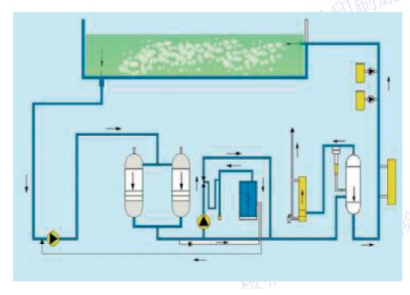
- The split flow ozone disinfection system only adds ozone to 25% of the circulating water for disinfection and then mixes it with 75% of the mainstream circulating water without ozone, dilutes it, and uses the remaining ozone in the split flow disinfection water to continue disinfection. This disinfection method reduces the volume of the reaction tank, and eliminates the residual ozone adsorption filter, thereby reducing the footprint, investment, and operating costs, while ensuring the disinfection and sterilization effect. This disinfection method requires minimal equipment and has a small volume, making it most suitable for the renovation of original swimming pools and the adoption of small swimming pools.